

Astronomy Object of the Month: 2026, April
< previous Archive
The dual nature of radio emission in early-type galaxies
Galaxies can be divided into two main types. Early-type galaxies are compact and consist mainly of old stars, and their radio emission
is primarily associated with the activity of the central black hole. In contrast, late-type galaxies have characteristic spiral arms and
a large population of young stars, which largely account for their radio emission.
Even among early-type galaxies, however, we observe significant differences. Some of them emit
radio waves from regions much larger than the galaxy itself, while others emit only from a small
region around the center.
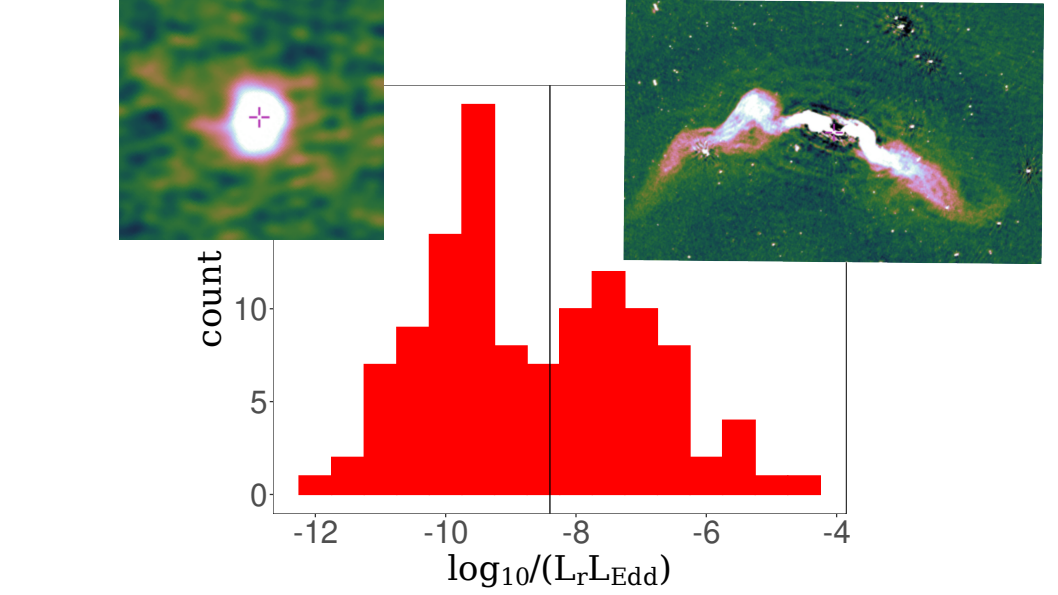
Illustration: Distribution of radio luminosity Lr scaled by the luminosity corresponding to the maximum accretion rate onto a black hole (LEdd). Two clear peaks and a minimum are visible, with the position of the minimum marked by a black vertical line. On the right and left sides of the histogram, radio maps obtained from the LoTSS DR3 survey are shown, illustrating the typical radio morphologies of objects located respectively to the right and left of this minimum. (The Authors).
A team of researchers from the Astronomical Observatory of the Jagiellonian University set out to investigate what causes these differences. They analyzed radio data for a small sample of nearby galaxies, selecting only those for which the masses of the central black holes had been measured with very high precision.
It turned out that galaxies fall into two distinct groups. In so-called radio-bright galaxies, the emission is dominated by particles accelerated in jets – powerful streams of matter ejected from the vicinity of the black hole, which can extend over enormous distances. In contrast, in radio-weak galaxies the emission is much fainter and is mainly associated with residual star formation processes. These galaxies typically host less massive black holes and exhibit more compact radio emission.
Interestingly, this second group also includes galaxies hosting the most massive black holes. In their case, the radio emission originates directly from the galactic nucleus and is relatively weak, which may indicate that the activity of the black hole is episodic in nature.
Moreover, radio-bright and radio-weak galaxies occupy different regions in the diagram showing the relation between black hole mass and the velocity dispersion of stars in these galaxies. This suggests differences in their evolutionary histories, most likely related to different merger and interaction histories with other galaxies
Original publication: Wójtowicz, A., Werner, M., Stawarz, Ł., Cheung, C. C, Driver behind the bimodal distribution of Eddington-scaled radio luminosity in nearby early-type galaxies , Astronomy & Astrophysics, 708, A2 (2026).
The research described is part of the research topics conducted at the Department of High Energy Astrophysics of the Astronomical Observatory of the Jagiellonian University in Kraków.
|
Anna Wójtowicz Astronomical Observatory Jagiellonian University Anna.Wojtowicz [at] uj.edu.pl |
