

Astronomy Object of the Month: 2026, June
< previous Archive
New pulsating hot subdwarfs discovered with the TESS satellite
International team of astronomers led by Jerzy Krzesiński has discovered 42 new hot subdwarfs, including 22 new pulsating stars, 3 candidates for systems containing
a pulsating hot subdwarf, and 13 new candidates for close binary star pairs. The discoveries are based on the analysis of observations made by the TESS satellite,
monitoring changes in the brightness of millions of stars in the sky.
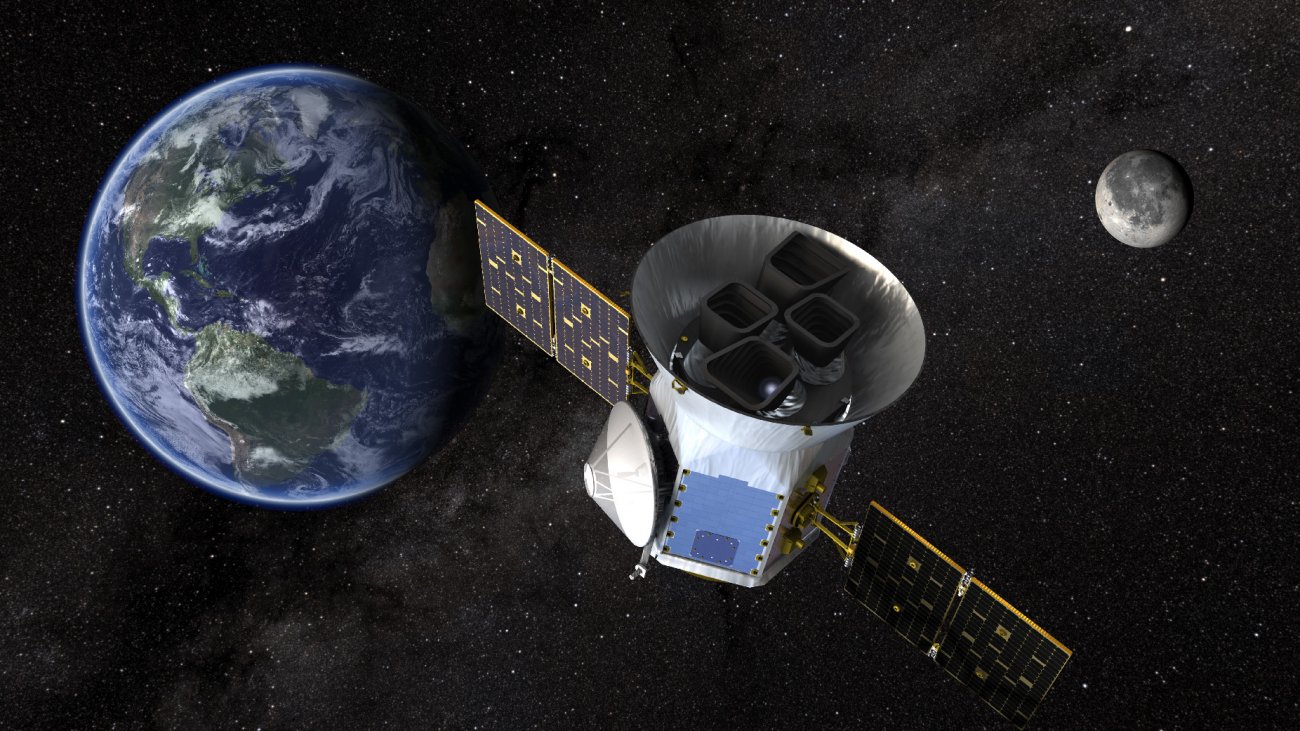
Illustration 1: The TESS (Transiting Exoplanet Survey Satellite) space telescope designed to search for exoplanets using the transit method (NASA).
Hot subdwarfs are a unique class of stars. They are extremely hot objects with surface temperatures ranging from about 20,000 to as high as 80,000 degrees Kelvin — several or even a dozen times higher than the Sun’s surface. At the same time, they are relatively small: their radii are typically about 20% of the Sun’s radius. In fact, they are the exposed cores of former red giants that have lost nearly all of their outer hydrogen envelope. Helium fusion continues in their cores, which is why they remain hot and bright despite being small. Once this fuel is exhausted, they skip the later stages of evolution typical for ordinary stars and evolve fairly quickly to white dwarfs.
The formation of hot subdwarfs is closely related to the evolution of binary systems. When the synthesis of helium from hydrogen ceases in the core of one of the stars in such a system, that star begins to transform into a red giant. Its core contracts, its temperature rises, and its outer envelope expands rapidly. In some cases, this vast envelope covers the second component of the system, leading to the formation of a so-called common envelope. The interaction of the stars with the matter of the common envelope leads to the loss of their orbital energy, the components moving closer together, and a significant portion of the envelope being ejected into space. As a result, all that remains is the hot, exposed core of the red giant — a hot subdwarf — and a close companion orbiting it. Under some circumstances, this process may lead to the merging of both components into a single object. This is one of the possible mechanisms resulting in the formation of isolated hot subdwarfs.
A particularly interesting group consists of pulsating hot subdwarfs: stars whose brightness varies due to oscillations occurring within them. Analysis of these pulsations allows astronomers to study the internal structure of stars using asteroseismology, just as seismologists use seismic waves to study the Earth’s interior.
The search for new objects proved to be a large-scale project. The authors began with a catalogue of over 61,000 candidates for hot dwarfs, previously selected based on data from the Gaia mission. After correlating them with objects observed by the TESS telescope and applying additional selection criteria, the authors obtained a sample of approximately 3,300 objects, which were subjected to in-depth analysis. Light curves from the TESS satellite were used for this research. For each object, it was verified whether the observed changes in brightness actually originated from the studied star, rather than from neighbouring objects within the satellite’s field of view. This was done using the TESS-Localize program, which allows the location of the source of variability to be determined directly from TESS images. It became apparent that some signals initially attributed to the hot subdwarfs came from neighboring stars or were related to observational artefacts.
Analysis of the light curves initially identified 66 candidates for new hot subdwarf variables. However, only a detailed verification using the TESS-Localize program revealed that only 42 objects are real hot subdwarf variables. Among them were 22 new pulsating stars, 3 candidates for systems containing a pulsating hot subdwarf, 13 candidates for binary systems, and 4 objects of uncertain nature requiring further observation. This was followed by an analysis of the frequency of luminosity changes, allowing pulsating stars to be distinguished from binary systems, where variability may be caused by eclipses, the ellipsoidal shape of the components, or light reflection from a companion. Interestingly, some of the new pulsating stars exhibited only a single dominant frequency of changes in brightness, so their classification will need to be confirmed during future observations.
Spectroscopic observations were additionally made for 11 stars. The obtained spectra were analysed using the specialized XTgrid program, which allows for the determination of temperatures, surface gravities, and chemical compositions of hot stars. The classification of the observed objects as hot subdwarfs has been confirmed, and their basic physical parameters have been specified.
The research of Krzesiński and his team significantly increases the number of known pulsating hot subdwarfs and candidates for binary systems. Discovered objects will provide important data for further studies on stellar evolution, the loss of the common envelope and the mass transfer in binary systems, as well as the processes leading to the formation of white dwarfs. Particularly interesting are the new pulsating stars, which could become the subject of future asteroseismological studies that allow us to peer into the depths of stars. The authors also note that the rate of discovery of new pulsating hot subdwarfs is gradually slowing down. In the previous phase of the project, 61 new such objects were found, whereas 22 have been discovered so far. This may indicate that astronomers are slowly approaching the completion of a catalogue of the brightest pulsating hot subdwarfs observed by the TESS satellite.
Many of the newly discovered objects still require further photometric and spectroscopic observations. However, the results already demonstrate how effective the combination of huge databases from space missions with classical ground-based observations can be. Thanks to such studies, astronomers are gaining a better understanding of the late stages of stellar evolution and the processes occurring in close binary systems.

Illustration 2: Post-stamp CCD images obtained from TESS data for the object TIC 33770579 from two observing runs: sector 28 (left) and sector 29 (right). Red-hatched squares indicate the TESS pipeline aperture used for extracting the light curve. (The Authors).
Original publication: Krzesinski, J., Uzundag, M., Kumari, G. A. et al., A comprehensive search for hot subdwarf stars using Gaia and TESS: II. Uncovering new pulsators and close binary systems, Astronomy & Astrophysics, 700, 17 (2025).
The research described is part of the research topics conducted at the Department of Stellar and Extragalactic Astronomy of the Astronomical Observatory of the Jagiellonian University in Kraków. The project made use of ESA (European Space Agency) data from the Gaia mission, processed by the Gaia Data Processing and Analysis Consortium (DPAC, https://www.cosmos.esa.int/web/gaia/dpac/consortium).
|
Jerzy Krzesiński Astronomical Observatory Jagiellonian University Jerzy.Krzesinski [at] oa.uj.edu.pl |
